Editor's note: I have covered many ceremonies in my time at the Guardian. Many show the harsh realities of military life such as deployment ceremonies, others the happier such as welcome home ceremonies. But none bring the realities of war to light than Purple Heart ceremonies, where Soldiers, injured in battle are honored for their dedication.
-- Published in Fort Polk Guardian (Sept. 7, 2007) --
By: MICHELLE LINDSEY, Guardian staff writer
While on a routine night patrol in southwestern Baghdad Sept. 12, 2006, Private 1st Class Joshua Pettit, D Troop, 1st Battalion (Airborne), 509th Infantry Regiment, was manning a vehicle-mounted M2 heavy-barrel machine gun when the patrol was ambushed by a squad-sized element of insurgents armed with AK-47s and rocket propelled grenades. Pettit was struck in the chest by AK-47 fire, knocking him from his gunner position.
Disregarding his own safety, he immediately returned to his post and laid down suppressive fire on the enemy, foiling the ambush and causing the insurgents to retreat.
Pettit is one of nine Fort Polk Soldiers awarded a Purple Heart in a ceremony Aug. 31 at the Warrior Community Center. Pettit was also awarded the Army Commendation Medal with Valor for demonstrating exceptional courage under enemy fire.
“America's sons and daughters have answered the call to duty in this Global War on Terrorism, protecting our nation,” said Col. David Sage, Fort Polk garrison commander. “You are heroes of a modern day battle. A battle where terrorism is the accepted method of aggression, both against Soldiers and civilians.
“We are here to pay tribute to nine (service) members. These Soldiers have a great deal in common with the Soldiers of General George Washington's day -- volunteering to defend their country in its hour of need,” he added.
Sage said the warrior ethos of today's Soldiers is what ties them to the Soldiers of history -- their dedication to defend their country at the risk of personal sacrifice. He reminded the Soldiers honored at the ceremony that they now stand alongside other Purple Heart recipients in U. S. history, now considered American heroes.
“American Soldiers throughout the Army's 213 years have been cut from the same cloth. You are warriors. Your sense of warrior ethos and patriotism runs deep. Your country thanks you.”
Other Soldiers honored with a Purple Heart are:
-- Staff Sgt. Nathaniel Brown, A Company, 2nd Battalion, 30th Infantry Regiment, 4th Brigade Combat Team, 10th Mountain Division, for wounds sustained Dec. 7, 2006, when an improvised explosive device detonated near his vehicle while conducting convoy operations, resulting in multiple wounds to his right ankle and foot.
-- Sgt. Christopher Fodge, 204th Military Police Company, 519th Military Police Battalion, 1st Combat Support Brigade (ME), for wounds sustained Nov. 21, 2006, when a mortar detonated near his position at forward operating base Rustimyah, resulting in multiple wounds from shrapnel.
-- Sgt. Jovan Harris, 258th Military Police Company, 519th MP Bn, 1st CSB (ME), for wounds sustained Aug. 9, 2006, when his vehicle received a direct hit from an IED, resulting in shrapnel wounds to his face and left leg.
-- Sgt. 1st Class Mark Mackey, Headquarters and Headquarters Company, 4th BCT, 10th Mtn Div, for wounds sustained March 7, 2007, when a command-wired IED detonated, resulting in a grade II concussion.
-- Spc. David Miller, Headquarters and Headquarters Detachment, 519th MP Bn, 1st CSB (ME), for wounds sustained July 15, 2006, when his vehicle struck an IED, resulting in shrapnel wounds to his right arm.
-- Spc. Cindy Rosser, 91st Military Police Detachment, 519th MP Bn, 1st CSB (ME), for wounds sustained July 15, 2006, when her vehicle struck an IED, resulting in shrapnel wounds to her right leg.
-- Spc. Harry Thomas, 94th Brigade Support Battalion, 4th BCT, 10th Mtn Div, for wounds sustained as a gunner Dec. 18, 2006, when his vehicle was struck by a vehicle-borne IED, resulting in head wounds.
-- Sgt. 1st Class Charles Williams, D Company, 2nd Bn, 30th Inf Reg, 4th BCT, 10th Mtn Div, for wounds sustained Nov. 28, 2006, when his platoon came under heavy enemy fire and his vehicle received two direct rocket propelled grenade hits, resulting in shrapnel wounds to his left hand and right cheek.
For more articles in the Fort Polk Guardian, visit our
web page.
September 9, 2007
Troops injured in battle honored as heroes
Lounge leads to learning about leisure, laughter
Editor's note: In a previous post I told you that I was working on a commentary about attending various activities on post and writing about my experiences. Last week my boss decided that it was such a good idea that I should make it a series and write a commentary each week. This is the last of that series. As I previously posted, I accepted a new job offer and start tomorrow.
-- Published in Fort Polk Guardian (Sept. 7, 2007) --
By: MICHELLE LINDSEY, Guardian staff writer
In the past few weeks, I have explored a variety of options on post looking for activities to enjoy during my husband's pending deployment. While I enjoyed classes and programs I have participated in, I also wanted to find some places where I could kick back and relax. So when Sgt. First Class James “Jimmy” Coker, a friend I'd met on an assignment when I first arrived at the Guardian, asked if I would be willing to take some pictures of his fantasy football league's draft activities at the Sparetime Lounge, I jumped at the chance.
I don my husband's old Dallas Cowboy's jersey to get into character and head to the Sparetime Lounge.
I instantly feel comfortable when I arrive. There are tables scattered about surrounded by televisions of various sizes, even a few big screen TVs. In the back I notice a collection of pool tables.
“Hey Michelle,” Jimmy greets me as I walk towards the bar. “What do you want to drink? This one's on me.”
“Just a diet coke,” I reply as the bartender adds another drink to the beverages in front of him.
A group of guys walk up to the bar and Jimmy introduces me to the members of the Cajun Cutters, his fantasy football league. As we carry our drinks into a glass partitioned area in back of the lounge, I am introduced to others.
“We set up a table for you over here,” Jimmy says as he motions to a table near the pool tables.
“I don't know much about football, much less fantasy football,” I say as I grab my notebook.
“Let me explain,” he says as we walk over to his computer. After explaining the basics, other players explain their research methods for picking the right players for their teams.
“We research 364 days a year,” Jimmy said after I comment on how much work goes into preparing their league draft.
As other league members continue to arrive, I explore the lounge.
The bright-colored stools and chairs surrounding the bar area and pool tables give it a “pool hall” feel.
Sharing a building with the Stars and Strikes Bowling Center makes it convenient if you get hungry or competitive.
I head back to the football draft activities just in time to order lunch, a ham poboy. When it arrived, I could hardly wait to try it. I settle back into my seat and enjoy my sandwich as we wait for the remaining league players to arrive.
I continue to explore. I notice people bringing laptops and settling in to work and play. After talking to staff, I learn there are a lot of amenities at the facility, besides pool tables and TVs. Patrons can access the free wireless Internet, test their knowledge with the National Trivia Network system, or compete against others in electronic Texas Hold'em.
After a few hours of feasting on food and finding new friends, I realize that the Sparetime Lounge is a great place to hang out.
I check with staff members to learn about upcoming activities. Stars and Strikes Bowling Center and Sparetime Lounge host the late night Rock and Bowl beginning at 12:30 a.m. Fridays and Saturdays. If bowlers need a “break” from all their strikes, they can head over to the Sparetime Lounge and share their tales and tips with others.
Patrons can cheer on their favorite football team at NFL Sunday Ticket. The Sparetime Lounge will show nine games on 11 TVs.
Staff members also say that upgrades and renovations are planned for the future. I'm excited to see what else is in store for the facility. Maybe I'll see you there!
For more articles in the Fort Polk Guardian, visit our
web page.
August 29, 2007
Journalist finds more than club membership at Super
Sorry! I forgot to post this on Saturday ...
Editor's note: In a previous post I told you that I was working on a commentary about attending various activities on post and writing about my experiences. Last week my boss decided that it was such a good idea that I should make it a series and write a commentary each week. This is the fourth of that series. After sitting down with the command information office today, we are not sure when the series will end as we keep finding new areas to explore.
-- Published in Fort Polk Guardian (Aug. 24, 2007) --
By: MICHELLE LINDSEY, Guardian staff writer
In the past six months I’ve said goodbye to many close friends and it has left me feeling a little abandoned. Each friendship helped me grow in ways that I didn’t realize until they were gone. Charlotte Watson was my strength, with a shoulder to cry on and words of encouragement during the last deployment. Luz Montour was a mentor and coach as I looked to her for advice as a military spouse. Staci Chiomento reminded me to laugh. As the spouse of a fallen Soldier, she had more reason than many to be bitter, but she never lost her smile. There are many others whose friendships I treasure. Staying in touch with them has helped me learn that friends may move, but they never leave your heart.
As I reflect on those who befriended me, I look for ways to make new friends.
“I can’t stop making friends just because they will leave someday,” I scold myself as I look through the Guardian for a new activity to try. I notice the Officers’ Spouses’ Club and Enlisted Spouses’ Club are holding their joint Super Sign Up Wednesday. I make plans to attend.
“I’ve covered this event for the paper for two years,” I say to myself. “Maybe I should stop being a spectator and participate.”
As I pull into the parking lot at Warrior Community Center, I park in the overflow area in back because there are so many people already there.
“These clubs must be Fort Polk’s best activities for Families,” I mutter to myself as I pull into a parking spot. “Let’s see what’s inside.”
As I enter the building I am greeted with smiles. “Are you interested in OSC or ESC?” one volunteer asks. “Well, I’m eligible for OSC, but I was hoping to get some information on both to pass to some of the spouses in my husband’s unit,” I reply.
She escorts me to the sign-up table and says she will find the OSC president as I start talking to ESC members.
After getting some brochures from ESC, I walk around the Warrior Community Center looking at vendors booths.
“Hi!” I hear as I look over the long line of booths and try to figure out where to start.
“Hey!” I answer, recognizing Dawn O’Brien, a spouse I had met at the ACS Game Night.
“Can I answer some questions for you?” she asks as we move out of the way of the crowd.
“I was just wondering what some of the benefits are to joining OSC,” I say.
“Well, it’s a great way to make new friends,” she says. “It gets you out of the house and you get to be a part of something, which is why I joined. We have
monthly luncheons, which are fun, and fund-raising events such as The Creole Caddy Classic, the annual arts and crafts fair and Casino Night that members can help plan. I have a blast. Each year I get to meet so many people.”
“Sounds like it’s worth joining,” I say.
“Definitely. You should talk to the OSC president, Connie Conrad,” she adds.
“Well, I’ll let you get back to greeting people, thanks so much for the information,” I say as I head back to the vendors’ area.
There is so much to see, from programs offering activities for children to learning about merchants in the area. I am excited about the possibilities.
I stop by the Bayne-Jones Army Community Hospital Community Health Nursing table, where I pick up information on pandemic flu and learn about over-the-counter medications class.
As I move through the area, I am intercepted by an ESC member who offers to introduce me to Scarlett Sharkey, the ESC president, to answer any questions I have.
Upon introductions we realize that we’ve already met before at the ceremony when her husband assumed responsibility as Fort Polk’s garrison command sergeant major.
“Hi! I am eligible for OSC, but I was wondering if I could ask some questions about ESC to pass along to other spouses in our unit,” I say.
“Sure, what can I help you with?” she asks.
“Well I was wondering if you could tell me about ESC and how spouses benefit from it,” I ask.
“This is a great place to meet friends,” Scarlett says.
“We are trying to offer a variety of programs and events through ESC to reach every (enlisted) spouse on post. We have an incredibly diverse group of spouses here –– with children or without, various ages. We want to offer different activities so that every spouse can find something they enjoy,”she adds. “We do a variety of things and the areas that we support are diverse as well. An example is the (Christmas) toy drive. Last year we helped more than 750 children have a brighter Christmas. Another activity is the Bike Rodeo (Saturday).
“These activities are a chance to interact with other spouses. Our motto is ‘friendships made here’ and that is what we want to offer spouses. We also host mini clubs such as cooking or reading, where spouses can meet others who share their interests.”
“That’s great,” I say. “I used to get information from Charlotte Watson about the program when spouses had questions, but since she left I didn’t know who to ask.”
“Charlotte was really great, but I’ll take her place as a friend and source of information if you want,” she says.
“Well it’ll definitely be easy to go from Charlotte to Scarlett,” I reply with a laugh. “Thanks so much for answering my questions.” After getting her contact information I head off to find more treasures.
“Who knew that making a friend could be so easy,” I ask myself as I begin filling out the sign up form for OSC. I make a mental note to e-mail Charlotte later
because she was always encouraging me to try new things.
As I finish talking to the OSC members at the sign-up table, I see Connie Conrad, president of OSC.
“Hi, I was told you might have some questions about OSC,” she says, after greeting me.
“I do. I already signed up but I was wondering if you could give me some information about what spouses can gain from being a part of OSC,” I say.
“For me, OSC has opened so many doors to meeting people in the military and surrounding communities of Leesville, DeRidder and Rosepine. You belong to a club that works for the community. That helps open your eyes to what is here for Families.
“It also offers support. Sometimes you don’t realize how you need that until a deployment comes up or you become a new parent. And, after a while, acquaintances become friends.”
After I leave Connie, I realize that even having been married only three years, I still have experiences and knowledge that may help others and it’s my turn to impart that knowledge. I guess being a military spouse is a give-and-take relationship in that sense. You will never know if your experiences can help someone else. Just as my friends helped me, maybe now is the time for me to help others.
My stomach reminds me that I haven’t eaten so I head for lunch at the Warrior Deli.
As I drive back to the office, I think about today’s events. I went searching for friends and found more than I thought I would. Strangers become acquaintances, acquaintances become friends and, in the military life, those friends can eventually become the strength that gets you though the hard times and the laughter that fills your heart with memories to last a lifetime.
“I guess Fort Polk teaches more than just military skills. I definitely learned a lesson,” I say to myself, as I drive back to work. “I have a lot of friendships yet to be made here.”
For more articles in the Fort Polk Guardian, visit our
web page.
August 18, 2007
Lessons learned: Seeing Polk’s beauty through Sgt. Major’s eyes
Editor's note: In a previous post I told you that I was working on a commentary about attending various activities on post and writing about my experiences. Last week my boss decided that it was such a good idea that I should make it a series and write a commentary each week. This is the third of that series.
-- Published in Fort Polk Guardian (Aug. 17, 2007) --
By: MICHELLE LINDSEY, Guardian staff writer
Veterans of deployments, whether Soldiers or Family members, can tell you that despite the best laid plans, there will be times of stress and feelings of being overwhelmed. I admit that during my husband’s previous deployment, I sometimes wanted to grab my puppy, crawl into the deepest part of my closet and stay there until my husband walked through the door. Unfortunately, my closet is not big enough to pack all of the food and supplies that I would need to camp out there.
As another deployment looms, I try to think of creative ways to relieve stress that won’t relieve me of too much money.
I grab our dog, Sgt. Major, and a bottle of water and decide to explore my neighborhood, hoping some time in the sun will help me discover what I am looking for.
Inquisitive dog that he is, I know it will be a slow expedition. As he sniffs trees and anything else low enough for the nose of an English bulldog, I realize that maybe he has the right idea. Why should I be looking elsewhere for entertainment when it’s right in front of me?
Fort Polk is brimming with nature, a display of beauty offering a rainbow of color. With housing areas nestled in wooded areas, residents can catch glimpses of frolicking deer or shy rabbits during the right season. Magnolia blossoms and other fragrant flowers fill the air with a heavenly scent when in bloom.
As Sgt. Major pulls me along, exploring branches and light poles, I too explore, seeing our usual path in a new light.
“The grass has started to thicken since Picerne took over the housing areas. It looks so inviting in some places,” I say to myself, and as if on cue, Sgt. Major decided to roll around under a tree.
“Maybe later I’ll join you,” I say to him with a laugh as he gets up and shakes the grass off his coat. “Let’s see what else we can find.”
He greets some other dogs along the way, others he completely ignores as some phantom scent catches his attention.
As we walk past the small park in our neighborhood, he sits and watches children play.
“Too bad they don’t have a playground for you,” I tell him when he looks at me with pleading eyes. A few children come closer to pet him. He tries to remain sitting, but his back end shakes with excitement at the extra attention.
We begin our exploration again as the children return to play. We head for a wooded area behind the park and I let his leash out completely as he explores the bushes and logs.
“Those ivy covered trees are beautiful, don’t you think?” I ask him, but he is too busy with a spider on a log. “I wonder if wild berries grow back here?”
We follow the spider for a while before it realizes it is being stalked and scurries away. A squirrel catches Sgt. Major’s attention and we’re off again.
After losing him in a tree covered with pink flower clusters, my little explorer turns his attention to the mailboxes.
“I guess you never know where you’ll find something interesting if you don’t give it a chance,” I say to him as he circles the post, looking at it from all angles.
After a while, we head back home for some ice water and rest in front of the fan.
As Sgt. Major settles in for a nap, I wonder what other Fort Polk “secrets” I’ve missed by not giving them a chance.
I make a list of other places to explore –– North Fort trail, Marion Bonner Park, and more. I guess in the end, where you are stationed is what you make of it. If Sgt. Major can be entertained by a mailbox, surely I can find something here for me.
So I challenge you, find something new to do as a Family. Whether it’s afternoons in the park or exploring nature on one of Fort Polk’s trails, it’s what you make of your life that counts. Family memories are not valuable for where you were, but for what you did. Your next adventure may be only a walk away.
Cutline: Sgt. Major searches for the squirrel that got away while exploring Fort Polk.
For more articles in the Fort Polk Guardian, visit our web page.
August 10, 2007
Facing fears, fabricating fashions facilitates finding friendships
Editor's note: In a previous post I told you that I was working on a commentary about attending various activities on post and writing about my experiences. Last week my boss decided that it was such a good idea that I should make it a series and write a commentary each week. This is the second of that series. I'll post pictures later ...
-- Published in Fort Polk Guardian (Aug. 10, 2007) --
By: MICHELLE LINDSEY, Guardian staff writer
Starting something new is always exciting for me ... until I get to the class. Then the fear of being "the new kid in school" kicks in and I hang back hoping to blend in.
In my quest to explore programs and activities to occupy my time during my husband's next deployment, I put aside my insecurity and signed up for the deployed spouses craft class.
As I walk into the Army Community Service Center I can feel the excitement build, like a child in a candy store. As I open the large, white door, the cool air hits me, pushing away the heat of the Louisiana summer and a little bit of my confidence.
"I have been here a thousand times, why the hesitancy now?" I chide myself as I inquire about the class. But still, as I am directed to the classroom, I can feel the insecurity creep in as I take a seat in the back of the empty room.
"What if I'm not good at this project? Will I be the only new person?" The questions race through my mind. "This should be fun," I say aloud hoping to regain some of the confidence from earlier.
I place my bag on the floor as staff members and a spouse enter. "Hi, Michelle," a staff member calls out to me. "We're going to be in this classroom," she adds, pointing to the partitioned area beside me.
I smile and offer greetings as I grab my bag and walk to the smaller room. I take a seat as staff begin unloading plastic containers with beads on the table next to me. My curiosity piqued, I begin craning my neck trying to get a preview of what we will be doing.
"Hey, Booger," I hear from over my shoulder. I look up, smiling because I'd know that greeting anywhere –– Sammie Rogers, Relocation Program manager.
"Hey, Mrs. Sammie."
"I'm glad you could take time out of your busy schedule to join us," she jokes.
I'm glad I was able to get out of work," I reply with a smile.
“That’s always fun,” she says, laughing.
The door opens as two more spouses arrive to take their seats. Sammie greets each of them with the same cheerful attitude. I recognize one of them, my neighbor. We haven't interacted much –– just to wave in passing.
I move to sit beside her as the class starts, a bold move for me. The chattering and laughter are almost immediate, more like a group of old friends than people I had just met.
I start slow, pulling a few pink beads from the plastic boxes on the table. Others jump right in placing a variety of colorful beads on the plates provided. I’m unsure of where to start and decide a pair of pink earrings are in order because I didn’t want to take all of the pink beads.
“I made a bracelet with those beads and they break easy so be careful,” one spouse says to me.
“Thanks. I’ll keep that in mind,” I say with a smile, recognizing her from another class.
I quickly bead a short piece of wire and another spouse shows me how to hook them onto the earring loops. I decide to make a matching bracelet and start gathering beads as I talk with my neighbor.
“You know, my puppy loves to watch your girls play. I can’t even distract him with treats,” I say.
She laughs and tells me about a recent trip to the park with her daughters. We talk about the Louisiana heat and how it limits the time we can spend outside, occasionally stopping to remark to other spouses about their projects.
As we work on our projects, staff members from other ACS programs stop by to chat and offer comments about the projects.
“It’s great that the spouses become used to the staff in a setting like this. They may feel more at ease if they need to use a service here because they’ve already met some of the staff,” I say to myself as I watch a staff member and spouse discuss what beads would look best on a necklace.
“Ugh, my fingers are so numb from trying to get this clamp on,” I remark, turning to my neighbor with a laugh, “I would never have the patience to do this professionally.”
“Try it with this,” she says, handing me a small link.
Mrs. Sammie stops in front of our table to look at our projects and proclaims them “just beautiful!”
As I begin gathering beads for a necklace, Mrs. Sammie tells us a story of her grandson and a friend visiting over the weekend. We laugh and share stories of our own childhood antics and how our parents dealt with them. Some spouses share stories about their children.
I look at my watch and notice that the two-hour class is nearly over. I begin another necklace as other spouses comment on my previous one.
“I like her earrings and necklace,” I say pointing to another spouse’s black and brown combination.
“Hold on, let me see your earrings. I want some like that,” one of Mrs. Sammie’s staff members says.
“I used these beads,” I reply pointing to the pink beads, as I start on one last bracelet before class ends.
Mrs. Sammie joins us again as we show off our jewelry like it was worth millions.
“Those are beautiful!” She exclaims. “Oh! I am so jealous!”
“Well if people ask me where I got them, I’ll just have to say they are Michelle Lindsey originals,” I say with a laugh.
As we start to put the crafts away, we show off our handiwork to each other, exclaiming how creative the pieces we made are.
“When is the next class?,” I ask Mrs. Sammie.
“August 20 at 6 p.m.,” she said, checking with her staff.
“I’m definitely coming,” I remark with a laugh. “I don’t know why you didn’t tell me about this class before.”
“Booger, I’ve been telling you about this forever,” she says with a smile and hands on her hips.
“I know. Why did I wait so long?” I exclaim while putting my jewelry on and gathering my bag.
“I don’t know, but you’re always welcome,” she says.
As I walk to my car with my “Michelle Lindsey originals” proudly displayed like a little girl at a tea party, I make a promise to myself to try new things and not let my fears stop me. I’ve missed out on a lot in the three years I’ve been at Fort Polk because I was scared. But with a new resolve, I’m off to find more adventures. Who knows what’s next.
For more articles in the Fort Polk Guardian, visit our web page.
August 4, 2007
Journalist searches for cure for deployment blues, boredom
Editor's note: In a previous post I told you that I was working on a commentary about attending various activities on post and writing about my experiences. Last week my boss decided that it was such a good idea that I should make it a series and write a commentary each week. This is the first of that series.
-- Published in Fort Polk Guardian (Aug. 3, 2007) --
By: MICHELLE LINDSEY, Guardian staff writer
Boredom –– an enemy to many, but none more than to the Family members of a deployed Soldier. Long days, lonely nights, and an empty chair at the dinner table make the separation as daunting as mythological Sisyphus condemned to roll a large rock up a hill. Upon reaching the top, the rock rolls back, and the task has to be repeated. Like that rock, the cycle of deployments can be overwhelming.
But in all fairness, life is what you make of it.
So as my husband’s unit prepares for another deployment, I decide that maybe I should take the time to prepare as well. Through my work at the Guardian I learn about many activities on post –– activities that can keep me busy and help me meet new people. From ways to better myself to getting creative, I make a list of what I am interested in and work it into my schedule.
What I discover while exploring Fort Polk is a collection of activities to help Family members stay busy while their Soldier is deployed.
This week I try a class Wheelock Bayou Fitness Center. Every New Year’s we make resolutions to eat healthier and exercise more, but why wait until January? The upcoming deployment will give me that “kick start” and deadline to motivate me.
There are a variety of aerobics classes to choose from so I make a list of the classes that will fit my schedule, be in my physical ability level and help me reach my body fitness goals. I sign up for a lunchtime ab class.
I am a bit shy as I arrive early. No one is in the aerobics room yet so I set my stuff to the side and wait for others to arrive. Soon they started filtering in. The instructor enters and turns on some upbeat music as people begin stretching.
I set up my station, strategically placed, so I cannot see myself in the mirror-covered walls, a little apprehensive about what I am getting into. I admit, I am thinking about chickening out since I am a little self-conscious about working out in front of people, but I decide to stick with it. It’s only 30 minutes.
Class begins with stretching using an aerobics ball. “Not bad,” I say to myself, even though it takes me a few minutes to figure out how to balance and do the exercises.
Crunches, leg lifts and a combination of other exercises are my only focus as I concentrate on balancing on the ball. Some exercises are new to me and others boost my confidence. Before long we are stretching again.
“What? Class can’t be over.”
Sure enough, I look at my watch and realize that my 30 minutes is up.
“That was a breeze. I’m definitely putting that on the maybe list,” I say as I put away my equipment.
On my way out of the gym I pick up a list of other classes that Wheelock offers.
Wheelock features a cardio center, weight station and stretching area with floor mats which would allow me to workout after work if I can’t make it at lunch. Personal trainers are also available in case I need help reaching my goals.
There is a rock wall, something I enjoyed in college, and aqua massages for the times I get a little overzealous.
Basketball sounds fun, but I haven’t played since high school.
The gym’s cardio section has a lot of with equipment including bicycles, treadmills and elliptical steppers. I work out longer when I am entertained, so the option to listen to any of three television channels or three radio stations is definitely valuable.
For an added challenge I am considering participating in the “treadmil club.” All I have to do is log my mileage from the gym’s treadmills and soon I’ll earn a T-shirt proclaiming my achievements.
Although my abs are still a little sore, I am anxious to see what else I can find. I think I’m in the mood to get creative, but you’ll have to read about what I choose next week.
For more articles in the Fort Polk Guardian, visit our web page.
July 25, 2007
There's tons to do ... if you take the time to look!
Sometimes I manage to work a project here at the newspaper in my favor ... and this one I am pretty excited about, but a little background first.
During deployment here at Fort “Middle of Nowhere” I would hazard a guess that maybe 50 percent of the families go back “home” or to where their families are. With the recent increase to 15 month deployments there is reasonable cause to believe that these numbers could rise, which could be a problem for the economy. If you think about it, when our battalion deployed it left with 1,200 Soldiers. Not that is approximately 600 families (spouse and multiple children) leaving the area. Now there could be any number of battalions deployed at a time, but for math sake, let’s say that 5 are deployed ... that’s 3,000 families leaving the area and as I mentioned before we are in the middle of nowhere, as are many military installations (cheaper land!) That means that the base is a valuable source of income for the local community. But in the Army’s point of view, that is also 3,000 families that the units have the potential to loose contact with leaving them and their Soldier “disconnected” from what is going on. It is hard enough to see Soldiers come home with no one to greet them, but if their families could not be reached to notify them they are coming home ... well you see how sad that would be. But that is just one example of the problems that could occur.
So in it’s defense, the Army works HARD to ensure that families are not neglected when their Soldier deploys. That is why they implemented Family Readiness Groups, Morale and Welfare activities and the Army Community Service program which offers things such as new parent programs, financial counselors, volunteer programs, and so forth. That is where the fun comes in for me.
They have been trying to find programs and such to entice families to stay especially those school age children so they are not transferring schools and more than they have to. Last week I asked my boss if i could participate in a few programs and then write a commentary on my experiences ... she said “yes.” But here is the fun part, I get to do these programs “on the clock!” That’s right, so today is my first one ... I am going to the weekly sewing class. They have projects each week or you can bring your own. I’m a little excited. I am also going to a couple of exercise class offered by the post gym, taking a lunchtime stress management class, find some project to volunteer at and a few others. There is also arts and crafts classes offered at the ... Arts and Crafts Center (I know that one was hard to figure out!)
It’s is really great. During the last deployment I was busy working on my masters but with that nearly complete, there are a lot of things I can do during the upcoming deployment. I really pushed some of my spouses to get involved when the guys were gone last year and they enjoyed it. There are tons of classes or children below school-age like toddler playtime and infant massage classes.
there are a variety of reasons why people go home, I had a 19-year-old pregnant with TWINS! I definitely knew she would need her family’s support, but she moved back after the girls were born and the guys were home soon after that. But for those who choose to stay, there are a lot of things to do to keep busy. There's tons to do ... if you take the time to look! The arch enemy of the spouse of a deployed Soldier is boredom. That whole “idle hands” thing gets some in trouble.
July 24, 2007
My life is not like a box of chocolates (but I sure could use some!)
Well this week has truly been "one of those weeks." I have had so much to do that my head is spinning. The weekend was a blur because my husband was called into work BOTH day because of stupid decisions made by Soldiers (related to alcohol of course.) So I think the leadership are trying to figure out a way to stop the Soldiers from hurting themselves or others because, let face it, their lives are already in enough danger without adding to it with stupid decisions.
In the past month I have lost nearly all of my friends to PCS moves: “My Dear Watson”, Mezz, my date when hubby is gone, Staci, “Dixie’s Mom”, and a few others. These gals were my rock, sounding board, shoulder to cry on and in the case of Mezz, a little sister who needed constant care, which kept my mind off of the last deployment. Now, I am months away from another deployment and ... well it looks like it’ll be a quiet one, but I have plenty to keep me busy.
Last week was chaotic at work and this week is a little better, but we start on the Back-to-School edition that comes out the week school starts and I have to be honest. I have been stuck with this for the past four years and I HATE it. I don’t have kids so it’s wasted info on me. The bus schedule is always provided last minute so the day before we layout the paper I spend 8-10 hours typing it up because they send it in an spreadsheet format by street and school and I have to convert it to paragraph format by bus number. UGH!!!! Oh, the bad words that spew from my mouth. I have actually cried from so much frustration. On top of that it is an 8-page layout so I have to do a plethora of other articles and projects to fill it up. I beg you this one time of year, don’t edit your newspaper and complain –– some days it takes all we journalists have to get it together, especially when you get the project two week ahead of print time instead of two-months like previously. I know bus safety in my sleep, I could recite to you the lunch schedule and give you the damn immunizations myself. On top of it I have my regular assignments which this week include (but is not limited to:) a deploying unit and Dining Facility that won national recognition (It’s not all glamorous!) But on to other topics ...
The end of the semester is approaching fast and I have 11, that right not 10 but 11, papers to write including a 15-20 page research paper. While the hell did i go to sleep last night. I have class the first two weekends of Aug. and I gotta have SOMETHING to turn in.
On the home front, we have come to realize that Sgt. Major’s potty training has gone out the window since military housing changed our fences from wooden to the chain-link. That’s right people, my “I’ll bite your head off if you knock on the door or touch my mommy” guard dog is scared to potty outside by himself, so he has redesignated the floor beside the kitchen table as his new “hot spot.” George is going to try to find some sort of privacy fencing, but we cannot attach anything to the fences per the new regs. I say let’s drop Sgt. Major off at the housing office for a few days and see if they don’t change things ‘cause ol’ boy has some strong stuff coming out of his little body.
Speaking of george he leaves for four-weeks of training soon and it’s gonna be hard. Sgt. Major tends to get needy, I go on a house-cleaning binge and I hate the lonely night. A king-size bed is HUGE when you’re in it alone (even with a 60-plus pound bulldog.)
This Friday we are having his Bn XO over for dinner and while I absolutely ADORE the man because he is so funny (at least I think so!) I have got to remember to take the roast out of the freezer, bake some cookies (and not eat them) and get salad making stuff. Hopefully the produce gods will smile on me and the red potatoes in the pantry will not go bad Thursday night, like they usually do when planning a dinner party. I’m also hoping that a fellow Cpt. can make it for dinner too, ‘cause i want to grill him on his new fiancé before we get to the weeding in Sept.
On top of all that I voluteered to take on another position in the Family Readiness Group ... but more on that later.
All in all ... I probably had a lot better things to do than write this post, but I’ll chance it. I must get back to work. Life as an Army wife is NEVER dull!
July 12, 2007
Love of books leads journalist to adventure, finding herself
Editor's note: This is a a commentary I wrote recently Some people will tell you that I am a fanatic about books, but don't beleive everything you hear ... o.k. this one might be true.
-- Published in Fort Polk Guardian (March 30, 2007) --
By: MICHELLE LINDSEY, Guardian staff writer
I have been a princess in a foreign land, a detective on the hunt for a killer. I have traveled the open seas in a ship rocked by towering waves and run the jungle paths with refugees fleeing oppression. I have been a Navy nurse and an Army general –– all while curled up with my favorite pink blanket.
I have lived the adventures of a thousand lifetimes through books. Growing up in a large family, we had two entertainment areas –– in the tree house or our rooms. There was no television, radio, game systems or motorized bikes. I was the fourth of 12, living on a chicken farm in rural Louisiana.
The cost of sending so many children to private school was a burden my father and stepmother carried for many years before deciding to home school us. With so many siblings, our home looked like a one-room school house, but it gave us the opportunity to sharpen our individual skills rather than follow a mandated curriculum in a public school system.
I remember, even before my parents decided to home school, they made it a point to ensure we went to the local library regularly. It was one of the few activities we could do on a limited budget. Instead of feeling cheated, I fell in love.
The smell of worn leather, the crack of a new book’s spine opening for the first time and the delicate pages of an old edition –– dreams were made of these. Opening a book for the first time was as exciting as starting a new adventure. I never knew where I’d end up, but I couldn’t wait to get there.
Once we began home schooling, we went to the library more frequently. We had more time, interrupted fewer people and it was easier for my stepmother to keep track of where we were. Once I picked a few books, I would grab my favorite pink blanket and curl up in one of the overstuffed chairs or on the carpet beside the window with a view of the old oak tree that seemed to be bigger than the small-town library. I would begin reading, falling like Alice in Wonderland, into the world within the worn pages.
I would often get irritated with the sibling tasked to tell me we were leaving. More often than not, the bruises scattered randomly across my legs and arms were from reading while walking, not playing on the farm.
My favorite books were from the Cherry Ames series, a mystery-solving nurse. I also enjoyed stories from the Victorian Era, classics such as Tom Sawyer, and mysteries. I read “War and Peace” in the eighth grade, though I admit, it was a bit complex.
As I grew older, I fell more in love with books. While other girls dreamed of being actresses, dancers and princesses, I wanted to be a writer. I admired those who could make words come to life. If I couldn’t be a writer, I wanted to be an editor, if for no other reason than to be the first to read a story.
My maternal grandmother was an elementary educator, and family vacations were always educational adventures, from spelunking in caverns to exploring Indian reservations. She encouraged us not only to read, but also write our own stories. She instilled in me a love for adventure, which I relive in the pages of my journals.
In college, while studying chemistry, I took a creative writing class to fill my scholarship requirements and rekindled my joy of reading and writing. I was good at science and math, but it didn’t hold my attention the way books did. After completing my degree that semester, I re-enrolled for a degree in journalism. I had finally found my place.
Today, that love is still as strong as ever. I sometimes visit the library on my lunch break or weekends. My favorite stop at the mall is the book store, the smell of new books and fresh ink is soothing. During my husband’s last deployment I started on my master’s in military history, which opened my eyes to a new genre of books.
The library is where I get my inspirations, whether for work or my personal life. The rows of books beckon me to join them in the adventures captured between their leather binding. Life may be busy, but I always manage to find time to read, still curled up with that old tattered pink blanket. Each book, like an old friend, waits patiently on the shelf.
The greatest gift my parents could have given me was a love of reading. It has opened my eyes to a world that I might not have otherwise considered. Now I just take life one chapter at a time. I am a book whose pages are still wet with ink, waiting to be finished.
For more articles in the Fort Polk Guardian, visit our web page.
July 8, 2007
Red, White and Blue, but no preview
The 4th of July was a very fun day. The installation hosts and annual FreedomFest and I was tasked with covering it for the newspaper, but other than that we thought we might play golf, but the weather did not cooperate. We had received and invitation to the commander's house since we would be in town, which we thought would be a special treat.
His wife, although extremely busy with the duties as a VERY involve mother, Family Group Advisor, and whatever other requirements attached to the wife of a Lt. Colonel, recently told me she does needlework. We've talked about it a few times, but I am still hesitant to "make the first move" even though she has always made me feel welcome in her home whether I am there for an Army event or social or just a personal visit. I think I am most intimidated because first of all she is an amazing person and a great example of what a military spouse should be and I would be content to live in her shadow and soak up all I can from her. But I digress.
I decided that I would make a red, white and blue custard to bring so I started off working on it at 10 a.m. Now I KNOW custards are tricky, but I was convinced I could do it. Not so ... after 7 hours it still wouldn't set ... so I improvised, but most importantly my HUSBAND came up with the plan. I placed my Mikasa candy dish in the center of the matching serving tray. I surrounded it with strawberries then a circle of blueberries, then sprinkled white chocolate chips throughout the ring of blueberries. I filled the candy dish with vanilla pudding and placed a strawberry in the center. Ta da! Berries and chocolate with a pudding dip. We make a great team. Unfortunately, in all of my excitement, I forgot to take a picture, but here is a picture of my preparations of my patriotic dessert in the tart pan it was to originally be in.
Now, I am going to get that custard thing figured out, maybe make it for a social or something. I think I jinxed myself by taking a ton of pics of me making it in hopes of posting it here. That's how life is sometimes.
On another note, the FreedomFest was o.k. It was very wet thin year and unfortuately about 2/3 of the fireworks didn't clear the trees they set it up behind, but Monday there should be some pictures on the paper's website, www.fortpolkguardian.com. Hope everyone else had a great holiday.
June 27, 2007
Floral fantasies flourish
At the beginning of May George and I drove to a nearby state park that had reopened after a year. Hodges Gardens State Park was donated by the family of the man who created it in the early 50. It was a beautifully blooming place where we used to visit often. It had waterfalls that were breathe-taking but it has also since gone. In fact there are the only three flowers we could find. Maybe in the upcoming months they will plant more. 


June 6, 2007
Happiness is spelled F-A-M-I-L-Y

Here is our latest "family picture". See how helpful Sgt. Major is? He's helping daddy get something off his face. Anyway, I really am bummed tonight, I have the creative vibes going but it has been such a long, overwhelming day at work that I just don't have the energy to write in cohesive sentences. Anyway, I am working on two commentaries for work, so I'll post them here for comments, when I get them done. It tends to make me feel better when I get the edits back with red ink everywhere and you guys have left positive feedback. The problem with commentaries is that I have to do them in my free time so I tend to go back and forth changing things when I restart, so they tend to have more edits than articles I write from start to finish in one sitting. Later, I'm off for some R&R.
March 30, 2007
Journalist faces fire, walks away with understanding, gratitude
Editor's note: Last week I posted an article I had written for our local paper about a fire school held here on the military installation.This week I followed it up with a commentary, personal reflections from my time in "their shoes." It was an eye opening experience, even for me a former volunteer. I hope you get as much from it as I did.
-- Published in Fort Polk Guardian (March 30, 2007) --
By: MICHELLE LINDSEY, Guardian staff writer Smoke fills the room as I crouch low trying to find relief from the thick vapors that seem to have a life of their own. My chest tightens as I try to take small, shallow breaths, my eyes tearing. On either side of me, firefighters clad in heavy yellow suits and airpacks line the walls. Then I remember the camera.
I lift it to my eye and watch through the viewfinder as a fire instructor from the Louisiana State University Fire and Emergency Training Institute sets ablaze the left side of the wall in front of me. Smoke billows across the ceiling, forming small spirals and circles that are as beautiful as they are dangerous. I feel the gloved hand of another instructor on my belt loop as he pulls me away from the fiery beast. I can feel the heat build as I document the flames leaping through the air, licking at the walls above the firefighters.
Working as a staff writer for the Guardian has led me to some unusual experiences –– from military training exercises to infant massage classes. I often dismiss my fears in exchange for satisfying my curiosities when asked to participate in what I am covering for the Guardian. This was no different.
Fort Polk firefighters joined with fire departments from Sabine, Rapides and Beauregard parishes for the second annual Louisiana State University Regional Firefighters Mini School March 17-18.
“Are you enjoying yourself?” Greg Self, Fort Polk Fire and Emergency Services, asked with a laugh. “You know I am,” I replied.
Having worked with Fort Polk’s Department of Emergency Services personnel before, he knew I wouldn’t be shy about getting involved.
“Wait until they start exiting the simulator (where firefighters experience the characteristics and mannerisms of a flashover fire),” Self said. “It gets pretty hot, so you have to crawl on the floor to get to the door. Sometimes they stumble a little, so be careful,” he advises.
I watch in awe as smoke billows out from even the smallest openings of the mobile building. “I can’t imagine what 1,100 degrees feels like,” I comment.
As Self explained the gear and safety equipment I was reminded of a close call my uncle, a Houston firefighter, had a few years ago and how these items saved his life. For me, being around emergency personnel is nothing new. My mother was a police officer, my brother a volunteer firefighter and emergency medical technician. I even volunteered for a while, but I am still amazed at the risks these people willingly take to help others.
A few minutes later, David Manning, LSU instructor, exits the simulator. Self points to his helmet.
“It melted,” I exclaim, trying to get a closer look. The front bubbles where the heat won the battle against the plastic.
“That’s why the students put aluminum on their helmets,” Self said.
“Would you like to suit up?” Jack Canton, LSU instructor, asks.
“Are you kidding?” I ask. A few minutes later I was “suited up.” From boots to bunker gear, I even had a helmet and gloves though I did not wear them for long.
“Looks like you’re ready,” said Michael Kuk, chief, Fort Polk FES.
“Bring it on,” I said with a laugh.
For the next few hours I walk around in the gear. It is heavy and cumbersome and I feel like a klutz as I try to maneuver through the different training exercises, photographing the activity.
In one of the exercises, fire instructors use a controlled propane leak to help students learn to work as a team.
“If you stand here you can get a great photo of (the instructor) lighting the tank,” another instructor advises as Self and I move to stand behind him.
I hold my breath as he opens the valve on the tank at his feet and vapors hiss through the larger training tank a few yards away. Seconds later a torch is lowered to the “leak” in the tank and with a “whoosh” the fire grows to a glowing five-foot ball of fiery reds and oranges.
Excited, I walk around in a wide arc snapping photographs as the firefighters work to control the flames. The heat of the fire mixes with the spray from the water hoses, creating a beautiful rainbow contrasting against the angry flames and heavy smoke.
I talk to many of the firefighters, watch them joking with each other, listen to their stories. A few ask if I want to join their departments. I admit for a minute I am tempted, but I realize their job is more than parades and Dalmatians. It goes beyond sliding down poles and rescuing kittens in trees. I may not have walked a mile in their shoes, but I did spend a few hours in them and realize that this is a unique group of people. They are true heroes. I’ve spent my life surrounded by firefighters in three states and realize they have one thing in common. They see each other as family and treat outsiders as lifelong friends. In their world there is no room for error, but there is plenty for family and laughter. Their job is dangerous, but they don’t do it for the glory or attention. They do it because they are needed. They run to danger when others run away from it. It is something that cannot be explained.
After spending a day in their shoes, seeing the dangers they face in training as well as on the job, there is only one thing I can say ... thank you. You are truly America’s homefront guardians.
Editor’s note: This was a controlled exercise. At no time was the reporter in any danger.
For more articles in the Fort Polk Guardian, visit our web page.
March 24, 2007
Educational fun!
 Don't laugh at me, at least I am not ashamed of my education! I joined a fellow staff writer in a trip to the Lake Charles Children's museum March 9 for an entertainment piece she was doing. Since I had done a piece on them last year, I knew it would be great fun. This time I didn't have to work, on drive her around since she was near her due date and it was an hour-long trip, so I got to play! Yeah!
  This manget man was not as easy as he looked considering that I had limited supplies, but it worked! There was a little boy who stood to the side and watched awhile, but then he joined in the fun too, until I was pulled away for more grown up activities ... playing in the bubble room. I learned to envelop myself completely in a soap bubble. Something everyone should learn because, like calculus, you never know when you will need it! (Hint: The trick is to go fast, not slow!)
March 23, 2007
Firefighters face flame, further fundamentals of fighting fiery fiend
 Firefighters face this fiery fiend March 17 at the annual Fort Polk-sponsored Louisiana State University Regional Firefighter’s Mini School. With nothing between them and danger except water and training, they form two lines bound together by trust and determination, battling a propane tank leak. Fort Polk firefighters joined forces with others from Vernon, Sabine, Rapides and Beauregard parishes to enhance their training.
Editor's note: I rencetly had the chance to cover the annual fire school they held here on post. I have worked the the Fire and Emergency Services personnel for 3 years now and have a special place for them in my heart, so when they offered to let me don gear and "get involved" in the story, I was excited. Below is the story publiished in today's paper. I hope to write a commentary about it for next week's paper, so check back next week ...
-- Published in Fort Polk Guardian (March 23, 2007) --
By: MICHELLE LINDSEY, Guardian staff writer
Twelve firefighters crouched low to the ground, watching the fire creep up the walls. The fire, like a beast, seemed to devour everything in its path while thick, gray smoke rolled along the ceiling in slow, swirling patterns. Their breaths were heavy, the intensity of the heat seemed to reach the core of their beings. Fighting human nature to escape this hell, they sat mesmerized by the lifelike form of the monster. Meanwhile, a few yards away, more firefighters were entangled in a heated battle with another fiery fiend, its hunger fed by the steady flow of a propane leak. This team of five, determined to be victorious, worked as one, their movements and skills united as they moved closer.
Though this may seem like the scene of Hollywood's latest movie, it isn't. Fort Polk's Directorate of Emergency Services firefighters joined with local fire departments for the Louisiana State University Regional Firefighters Mini School March 16-17.
“The fire school's goal is to get as many firefighters trained in the skills that we are teaching, so they will know how to perform (in these situations),” said Jack Canton, LSU Fire and Emergency Training Institute.
This is the second mini school held at Fort Polk.
“(LSU Fire and Emergency Training Institute) has been in Vernon Parish for training before, but the school at Fort Polk was a joint effort between Fort Polk Fire and Emergency Services and (LSU),” Canton added.
Michael Kuk, chief of Fort Polk's F&ES, said the school was inspired by his experiences as an LSU fire instructor at Fort Polk from 1979 to 1985. Kuk taught fire science courses and promised that if he returned as fire chief, he would institute a fire school to foster the camaraderie and teamwork of area fire departments. That promise was fulfilled when the program started last year.
“I liked the harmony and interfacing of area firefighters. It was a time for us not only to improve our skills, but also to network and get to know each other rather than wait for an (emergency),” said Kuk. “This year, not only did we have Vernon Parish firefighters, but those from Sabine, Rapides and Beauregard parishes.
“Not only does the school benefit us and the local firefighters, but it is also good for Fort Polk's reputation as a partner with local communities,” he said.
The school included 12 hours of classroom and field or interactive training.
Most students' field training “heated up” with time in the flashover simulator.
A flashover occurs when intense gas layers heat objects in the room to the point of combustion, said David Manning, LSU Fire and Emergency Training Institute instructor. The fire in the room may not need to reach the object, as the heat of it can cause ignition in a confined room or building.
Students, dressed in fire gear with aluminum foil covering their helmets to deflect heat and deter melting, sat inside the LSU flashover simulator where temperatures at ceiling level reach between 900 and 1,100 degrees Fahrenheit, Manning said. “Floor temperature is only about 300 degrees which teaches them quickly to stay low to the ground.”
The simulator recreates these conditions in a controlled environment through a small, portable metal building. Lumber was lit at one side of the building as firefighters on the other side witnessed first hand the charactistics of the fire's burn pattern.
Instructors and students agreed that continual training is valuable in saving the lives of firefighters and those they rescue.
“Training changes so much. No two fires are alike, so training helps firefighters learn to adjust. Fires don't happen every day at every fire department. Continuous training helps keep them on their toes,” said Canton. “Technology is also changing. When firefighters attend schools, like Fort Polk, they learn by training on this equipment.”
An example of the new technology is the locating devices firefighters attached to their gear at the training.
“The devices are instrumental in finding fallen firefighters,” said Greg Self, Fort Polk F&ES. “If the device is stationary for a certain time, then it starts to beep, slowly at first, then faster. The firefighter must start moving again or press a button (on the locator) to reset it. This can help rescuers find injured firefighters who may not be able to call out.”
Canton said the overall goal of fire training is safety and knowledge.
“Our number one goal is saving lives. If I can't save my own life, how can I save someone else's? This training helps firefighters save their lives and those of others,” Canton said.
Each year the school changes, offering students the newest training.
“We also host different classes, scenarios and specialties. Whatever the fire departments needs we try to provide,” said Canton.
The mini school offered two training programs this year. “The basic firefighter class taught the principles of why you attack a fire in a certain way, whether it is a building fire or a pressurized gas fire. They review case histories and learn the approach of fighting fires,” said Kuk. “The officer strategy and tactics class teaches overall firefighting movement as a commander as well as how to work with personnel. As leaders, they have to develop themselves because they must address a variety of management issues.”
LSU Fire and Emergency Training Institute provided a flashover simulator, portable cascade system, LPG (propane) prop and a maze trailer for training as well as six LSU instructors and three guest instructors from local fire departments.
“The school is essential training for new recruits and a much-needed refresher for seasoned firefighters, “ said Eric Stracener, guest instructor who works for the DeRidder Fire Department and volunteers at Rosepine Fire Department. “By working with other fire departments we become familiar with each other's equipment and personnel. It builds teamwork. We don't operate without teamwork. It is part of our life. This feels like a family reunion,” he said of the two-day school. “Firefighters are essentially one big family whether we know each other or not.”
Students included Soldiers as well. While Soldier firefighters are used in the Army, Fort Polk has not housed a unit until recently.
“I think the last military firefighter that might have been here was me in 1969,” said Kuk, referring to his prior service with the Army.
“That military occupational specialty was a very small one and now, because of the war and the critical depots and supply points that need to be protected in Iraq and Afghanistan, Army leadership realized there needs to be a stand up and enhancement of the MOS in general.
“They (Soldiers) work with us, learn the same skills and get the same certifications as (civilian firefighters). They receive real on-the-job training by working with (civilian personnel). They are a valuable part of our (team).”
More than 80 firefighters participated in the school.
“It was a great training experience. I practiced some needed skills. It was a good simulation of the real thing,” said Spc. Diego Rincon, 524th Engineer Detachment, 46th Engineer Battalion, 1st Combat Support Brigade. The 524th Soldiers are Army firefighters operationally assigned to the Fort Polk Fire and Emergency Services. The unit arrived at Fort Polk in November, 2005.
“Working with others helps you learn how people do things. You learn how a volunteer or community department works versus an Army fire department,” he added. “It helps build teamwork.”
“We want to keep this as a Fort Polk tradition, hosting annual training schools for local fire departments,” said Kuk. “I would like to host night sessions in the future. Night gives a whole new dimension and perception to fighting fires. It's something I look forward to.”
For more articles in the Fort Polk Guardian, visit our web page.
March 17, 2007
Dedication, determination leads to team being inspiration
Editor's note: I love covering sports for the paper, but rarely to I get a chance to do the "commentary" style such as the one below. This championship series however, as a nail-biter to the end, so I though some of you sports fans might like to see what sports on a military installation is like.
-- Published in Fort Polk Guardian (March 9, 2007) --
By: MICHELLE LINDSEY, Guardian staff writer It had come down to this night. Fourteen teams began the journey, but three teams would battle it out for the chance to be named the best. The victory would not be an easy one, but it would be a sweet reward.
The Fort Polk Morale, Welfare and Recreation Sports Division hosted the post basketball championship Feb. 27 - March 2 at 1st Combat Support Brigade Gym. The final three teams faced off March 2 to determine who would take home the title.
In the first game, 814th Engineer Company, 46th Combat Engineer Battalion, 1st Combat Support Brigade, battled it out against Medical Department Activity to determine which team would compete against the undefeated G Company, 94th Brigade Support Battalion, 4th Brigade Combat Team, 10th Mountain Division, for the title. Both teams came into the championship game with a loss. Another in this double elimination tournament would send them home.
The game started off at a fast pace, both teams eager to prove their skill. The 16-minute halves stretched to nearly an hour as players fought for supremacy. Players battled for victory amid minor injury, fatigue and technical fouls. The fast action was slowed only for time-outs and free throws as both teams gave it their all. Despite their efforts, MEDDAC fell behind and the game ended with a victory of 41-32 for the 814th.
After a brief break, 814th faced off against G Co. The engineers were the underdogs as they played with six players against G Co’s eight players. Not to be deterred, the engineers held strong against their opponents despite only a small break between games and one person for substitutes versus three.
In the first half, the two teams pitted their skills and team work against each other as the score leapfrogged from one to the other and the lead alternated. They kept the pace as airborne antics led to points and rebounds. As the buzzer signaled the half-time break, the 35-27 score placed the 814th in the lead. They didn’t get complacent though as they battled the undefeated team, climbing to a 13-point lead with 13 minutes left in the second half. Both teams fought viciously for rebounds, turnovers, steals and baskets, but with two minutes left, 814th had climbed to a 15-point lead. A free throw point and shot on rebound gave them three more points. Not ready to give in, G Co answered with a shot bringing the score to 59-44 in favor of the engineers.
After calling for a time-out with 21.6 seconds left, G Co scored again before the buzzer ended the game with a 59-46 victory for 814th.
Since both teams had each lost a game, they had to play another game to determine the winner. G Co started their second game with eight players, while the 814th was down to five after a player was injured in the second half of the previous game. The 814th would have to battle aggressiveness with control to stay in the game.
The third game started off with a clean tip from Jamorris Dickerson, 814th, to teammate Felix Macias. A fast break ended in a turnover to G Co, allowing Nick Phipps, G Co, to score putting the first points on the scoreboard. Not to be outdone, 814th answered with a three point shot putting them ahead.
The fast action under the basket and heavy defense by both teams continued and the tension remained high as players vied for open shots and rebounds. The first half of the game saw the lead score jump between teams as players raced up and down the court.
The crowd roared as players scored points and defended their basket. With 3:21 left in the first half, the score was even at 17 points each. Walter Major earned two points on a turnover, giving the 814th the lead.
G Co answered with two back-to-back shots, retaking the lead. The lead went back and forth as the two teams battled for supremacy. At the end of the first half, the score was 25-21, 814th Engineers.
The competition continued through the second half as players scored points and fought for rebounds. The stands shook with the excitement of the crowd as they cheered on their team. With two minutes left in the game, G Co led with a score of 41-39. Jamorris Dickerson, 814th, sank two free throws, tying the score with 1:34 left. Both teams scored, leaving the crowd in an uproar as the teams tied yet again with 1 minute left. Shawn Gibson, 814th scored two points from under a heavily guarded basket, followed by G Co’s Marcus Harper sinking a two-point shot, tying the score again with 6.7 seconds left.
The teams battled for one last shot and as the buzzer sounded, Larry Foster, G Co, shot from the top of the key. The shot bounced off the rim, signaling overtime, as the teams slumped in their chairs, tired and sweating. The score was tied at 43 points.
Five minutes later, the buzzer sounded again and the teams seemed to catch their second wind as they raced to the court.
Another tip-off gave 814th the first chance at scoring as G Co rushed to defend their basket. Defense was heavy as both teams fought to score. Time-outs and foul shots gave the players time for a few quick breaths, but their determination to win was evident. As teams scored, the crowds went wild, but neither team was willing to concede.
G Co –– then 814th –– took the lead, trying to run down the clock while their team was in control, but the determination of these players was equal as the final buzzer sounded with another tied score, 50 all.
Another small break gave the players time to rest, but the intense play was wearing on the smaller 814th team. Though defending their title was paramount, the team has already played three games and an overtime segment.
As the second overtime period started, they voiced that this would be the last one. They had to step it up and put their skills and hearts on the line.
The 814th gained possession yet again at the tip-off, but a turnover gave G Co the chance to score. Not to give up, Walter Major, 814th, answered with a score for his team.
After a time-out called by G Co, 814th stole the ball and earned two points giving them the lead at 52-50. The battle continued and with 1:45 left in the game. The score was tied yet again at 53.
Major put his team in the lead with a free throw point, giving them hope that they could win the game, but Nick Phipps, G Co, answered with a three point shot, retaking the lead with 56-54. After a free throw shot, G Co increased their lead by one point.
The 814th countered with a full court press, where Gentry Walker, G Co, fouled Major, earning the 814th two points. The score was 57-56 with 46.3 seconds left in the game.
G Co scored again bringing the score to 60-56. At 21 seconds remaining, 814th faced a decision as one of their five players reached his foul limits and left the game. Injured player Eric Nykowski removed the ice pack from his ankle and returned to assist his team, but it wasn’t enough as Phipps made two free throws bringing the score to 64-58. Jason Malek, 814th, attempted a shot at the buzzer, too late. G Co won, taking the title from the defending champs, but not without a valiant fight.
“Both teams played well, gave it their all,” said Robert Smith, Morale, Welfare and Recreation sports specialist.
He applauded the 814th Eng Co for not giving up. “You see their determination and dedication. They are definitely an inspiration.”
February 8, 2007
From English estates to American kitchens:
Tea whistles way through history into hearts of millions
-- Published in Fort Polk Guardian (Feb. 2, 2007) --
By: MICHELLE LINDSEY, Guardian staff writer From dyeing fabric to health benefits, from a flavorful treat to reading the future, tea leaves have become a part of life, though some uses for the leaves are less conventional than others.
This tiny treasure can be used to relieve tired eyes, give house plants a little extra boost or soothe sunburns. Tea is so versatile it can be served hot or cold. It is safe to say tea is no longer just for proper ladies or stately gentlemen.
Without tea there would not have been a Boston Tea Party in 1773, and Alice (in Wonderland) would have missed the adventures of the Mad Hatter and March Hare’s tea party.
Chinese legend claims that in 2737 B.C., a servant of the Chinese emperor Shen Nung was boiling water under a tree when some leaves blew into the liquid. Smelling the sweet aroma, Shen Nung, an herbalist, tasted the mixture that was accidentally created. The leaves were from a camellia sinensis tree and led to today’s version of tea.
Although the story is legend, it is supported by the fact that tea was a staple of China long before it was introduced in the west.
Tea became increasingly popular outside of China when its distribution increased through trade. It spread to Japan, Portugal, Holland and Britain. The turning point in tea’s history came with Catherine of Braganza, a Portuguese princess, married to Charles II of England from 1662 to 1685.
The love for the beverage brought it to the forefront and it soon became fashionable to drink at court.
The trend caught on and soon middle and upper class men and women began drinking it in their homes, but it was still too expensive for the working class. The high price of tea was mainly from a tea tax placed on the import of tea leaves.
“The monopoly on imports held by the merchants of the East India Company meant that tea prices were kept artificially high to protect profits, and on top of this the British government imposed a high level of duty,” states the United Kingdom Tea Council web site, www.tea.co.uk. “This created a demand among the British population for cheaper tea, and when that demand could not be met by legal means, a great opportunity was presented to those people who were less than concerned about breaking the law.
“Britons wanted to drink tea but could not afford the high prices. Their (desire for tea) was matched by the enthusiasm of criminal gangs to smuggle it in.
“What began as a small time illegal trade, selling a few pounds of tea to personal contacts, developed by the late 18th century into an astonishing organized crime network, perhaps importing as much as 7 million pounds annually, compared to a legal import of 5 million pounds,” states www.tea.co.uk.
Tea smuggling hurt the East India Co., a British trade company with monopoly to ship tea, financially and they struck a bargain with British Parliament to help their trade.
“On May 10, 1773, the British Parliament authorized the East India Co., which faced bankruptcy due to corruption and mismanagement, to export a half a million pounds of tea to the American colonies for the purpose of selling it without imposing upon the company the usual duties and tariffs,” states the Boston Tea Party Ship and Museum web site, www.bostonteapartyship.com.
“With these privileges, the company could undersell American merchants and monopolize the colonial tea trade.
“On November 27, 1773, three ships from the East India Co., the Dartmouth, Eleanor and Beaver, loaded with tea, landed at Boston and were prevented from unloading their cargo,” www.bostonteapartyship.com says. “(Colonists) demanded that the tea be returned to where it came from or face retribution. The Sons of Liberty, led by Samuel Adams, began to meet to determine the fate of the three cargo ships in the Boston Harbor. “On the cold evening of December 16, 1773, a large band of patriots –– the Sons of Liberty –– disguised as Mohawk Indians, boarded each of the tea ships. Once on board, the patriots went to work striking the tea chests with axes and hatchets as thousands of spectators watched in silence. Only the sounds of ax blades splitting wood rang out from Boston Harbor. Once the crates were open, the patriots dumped the tea into the sea,” www.bostonteapartyship.com claims.
“By 1784, the British government realized that enough was enough, and heavy taxation was creating more problems than it was worth. The new prime minister, William Pitt the Younger, slashed the tax from 119 percent to 12.5 percent. Suddenly, legal tea was affordable, and smuggling stopped virtually overnight,” the United Kingdom Tea Council web site reports.
Cheaper imports led to wider use of tea, including the eventual availability to working class people.
It would take more than a cup of calming chamomile tea to soothe the turbulence of this beverage’s history and journey to America, but today it has become a refreshing addition to daily life.
Studies show that tea is not only a popular beverage, but can also have health benefits. According to the United Kingdom Tea Council, a number of research studies conducted over the past few years have shown a range of health benefits from drinking tea daily. Benefits include:
–– As well as contributing towards your daily fluid requirement, drinking tea can offer some protection against heart disease as part of a healthy diet. Recent research shows that tea is a good source of flavonoids –– a group of compounds that have powerful antioxidant properties. And, the flavonoids in tea are soluble in water, so the longer your tea brews, the more flavonoids you get.
–– Like fruit and vegetables, tea is a natural source of flavonoids that generate antioxidant activity – in fact, there is more than twice the “antioxidant power” in a cup of tea than there is in one apple.
–– The health benefits of the antioxidants in tea are:
–– Antibacterial
–– Anti-viral
–– Antiallergenic
–– Anti-inflammatory
A large body of research indicates that antioxidants can help prevent heart disease and strokes.
Tea has stood the test of time, outliving fads and fashion. From tiny dried leaves to the tables in kitchens across the world, this delicacy turned durable staple has proved its staying power.
January 26, 2007
Foot Fetish Friday No. 11: Training for survival

This week I had the chance to follow a unit in the field for a training competition. It was fun and a coworked suggested this picture for my Foot Fetish Friday tribute. Continue reading to get the story ...
-- Published in Fort Polk Guardian (Jan. 26, 2007) --
By: MICHELLE LINDSEY, Guardian staff writer Stamina, determination, mental toughness, physical agility. Do you have what it takes? Soldiers of the 519th Military Police Battalion, 1st Combat Support Brigade, were put to the test this week as they competed in the rigorous three-day Warfighter Challenge Jan. 22-24.
The Warfighter Challenge is an annual competition where military police battalions throughout the Army send their best three-person team to compete in events that push the mental and physical limits of competitors.
“(The Fort Polk competition is) based on the military police mission and what the Soldier should know,” said Command Sgt. Maj. Mark Green, command sergeant major, 519th MP Bn.
He added that the annual competition changes each year and teams will not know what tests they will have to put their minds and bodies through until the competition begins. The annual competition will be held in April.
Soldiers from the 204th Military Police Company, 209th Military Police Company, and 258th Military Police Company, were selected by their leaders to compete in the Fort Polk challenge. Through this three-day competition, a team of three competitors and one or two alternates are chosen, said Green.
“The purpose (of the Warfighter competition) is to allow our military police to compete against others across the world,” said Green. “It gives (Fort Polk Soldiers) the opportunity to measure themselves, as far as their training and expertise, against the other military police in the Army.
“The goal is to celebrate being a military police Soldier in the Army and to have that spirit of competition,” he added. “To be selected as the best at your installation is already a huge accomplishment. (The Fort Leonard Wood competition is) about being the best of the best and it says something about what kind of Soldiers they are.”
Staff Sgt. Todd Pichette, a coach for this year’s team, is no stranger to the competition. He competed at Fort Leonard Wood in 2002 with a team from Korea and in 2003 with a team from Germany. His team placed in top slots both years.
Pichette served as a coach for the Fort Polk team in 2005 when they came home in third place out of 38 competing teams.
“The competition distinguishes which Soldiers and NCOs are top in the MP Corps,” he said.
Previous competitors take an active part in helping Soldiers train for the competition.
“I have some insight, but each year they change the competition. You can’t go back and train on exactly what was done the year before, but it is a guide,” Pichette said.
The competition is more than just an event –– it helps Soldiers improve themselves.
“The Soldiers are constantly doing tasks (related to military police work) and it sticks with them. They improve,” Pichette said. “They compete to be named the best. The team members (chosen) are already the best in the battalion and it motivates them to continue to get better and better.”
For first-time competitor Pfc. Greg Davignon, 209th MP Co, this experience has given him the chance to test his limits. “Some of these competitions push your physical and mental ability. I remember on the first day we had to carry a five-gallon water can through the woods and the march. Events like that push you to see what kind of person you are and what you are made of.”
The competition has helped him see what his strengths and weaknesses are and in the end can help make a better Soldier, he said.
“It shows me what my limitations are, how fast I can do things or how much I can handle. We had three companies compete (from the battalion) and I was put in a team with Soldiers I did not know. It helped me learn teamwork for activities such as the litter carry. It definitely builds battalion cohesion,” he added.
Davignon said he encourages other military police to participate in the challenge because it teaches lessons that “stay with you longer than the pain.” He added that no matter the outcome, once a team is chosen, the Soldiers of the 519th MP Bn will stand behind it when the time comes to compete.
“The (battalion) colonel and sergeant major have been behind us 100 percent, and the team that we send to Fort Leonard Wood will not have to ask or want for anything. We will be supporting them the whole way. Everyone is behind us,” Davignon said.
Click here to see other articles in this week's Fort Polk Guardian.
December 15, 2006
Drop zone named for fallen Geronimos
Editor's note: Wednesday I posted about an assignment that got a little personal for me. Here it is. I hope you get something from the sacrifice of these two Soldiers.
-- Published in Fort Polk Guardian (Aug. 1, 2006) --
By: MICHELLE LINDSEY, Guardian staff writer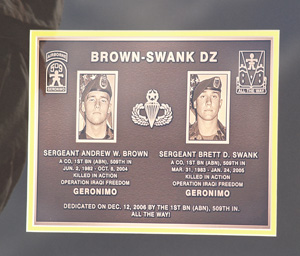 Tears mingled with laughter and pride as past and present Soldiers of A Company, 1st Battalion (Airborne), 509th Infantry Regiment, gathered with the families of two fallen Geronimos, Sgt. Andrew W. Brown and Sgt. Brett D. Swank, at the Beauregard Parish Airport Dec. 12.
Brown, 22, was injured Oct. 1, 2004, when his patrol vehicle was struck by an improvised explosive device. He was taken to a Baghdad hospital but did not stabilize enough to be brought to the States. Swank, 21, died of injuries sustained Jan. 21, 2005, when his dismounted patrol was struck by an IED.
Soldiers and families gathered at the airport to remember the sacrifices of Brown and Swank at a dedication ceremony renaming a portion of the airport the “Brown-Swank Drop Zone” in their honor.
Brown and Swank had more in common than rank and unit.
Both were from small, close-knit Pennsylvania towns. Both had dreams of becoming a Soldier, and fellow Soldiers claim both could make them smile in the darkest times. Both have brothers following in their military footsteps. Both Soldiers also gave their lives defending the nation they were so proud to serve.
“The military and the 509th have a long history of remembering those who have made the extreme sacrifice during their service to our country,” said Lt. Col. John King, commander, 1/509th. “We need to remember those who did not look for excuses, did not point their finger at someone else, but knew they had a duty to serve and went forward into harm's way.”
Despite not having served with Brown or Swank, King said the 1/509th is a family that remains true to each other despite separation.
“It is true I did not know Sergeant Brown or Sergeant Swank. They served in the battalion prior to my arrival. However, I did not know Private Brookins, who was one of the first 509th paratroopers, who jumped into North Africa and was killed in November, 1942, during World War II. I did not know Sergeant Miller or Private 1st Class Lowhorn, 509th paratroopers killed as part of their unit's airborne assault into the mountain country of Italy in September, 1943. I did not know Sergeant 1st Class Crane, a 509th paratrooper killed in Southern France in August, 1944, and I did not know Private Bills, a 509th paratrooper who was killed during the Battle of the Bulge in December, 1944,” King said.
Of all these paratroopers, especially Sergeant Swank and Sergeant Brown, I did not have to meet them to know how they had contributed to their fellow paratroopers in combat, the 509th unit and their country,” he continued.
“This is just an honor, a very fitting tribute to our son,” said Lourdes Brown, Brown's mother. “He loved his hometown, he loved his country, but he really loved the Army.
He loved to jump, so having this place named for him is very appropriate. It's perfect,” she said, fighting back tears.
The pride the Browns have for their son was evident as they spoke of his childhood love of the military.
“We knew he was going to join the military when he was 9 or 10 years old,” said William Brown, Brown's father.
“He played in camouflage. We used to have to go to Army-Navy surplus stores and buy him camos,” Lourdes added.
“He would have worn those clothes to school if it had been possible,” William said. “There was no doubt in my mind he would (serve).”
Brown joined the military shortly after his high school graduation, his parents said.
“He did not want to go to college. He wanted to go straight into the Army. He graduated in June and left for the Army in August,” Lourdes said, tears once again glistening in her eyes. “He always wanted to be in the infantry. It wasn't what I wanted, but it was his choice.”
Their pride has spilled over to his fellow Soldiers of the 1/509th. The bond the family and Soldiers have developed was evident as Brown's parents called Soldiers by name and hugged them. Lourdes even mothered them a bit, inquiring about one Soldier's cough and another's family.
The Browns said the 1/509th Soldiers never waivered in their support of the family. “We are a close family, but we never knew how close Andy's family in the Army was. It was a very strong bond, and they have been so supportive of us and kept in close contact,” Lourdes said.
The Browns said the reality of how close the unit is came to light when they learned his fellow Soldiers slept on the ground outside of the Baghdad hospital tent.
“The men of the 509th stayed with him 24-7, never leaving his side. For a mother who couldn't be there to help her child, this was important,” Lourdes said. “Those men were there with him and stayed until the end. That was really important. I owe them so much.”
“The most painful thing was knowing he was there and we couldn't be there,” said William.
Seeing them today shows us how much they care. Some of them came from other bases, having left the 509th,” said William.
Swank's father, Daniel, and stepmother, Becky, agreed that the relationship they developed with the unit has helped them get through their son's death.
“They have kept in touch,” Daniel said. “(They call) in January, the anniversary of when Brett was killed, Memorial Day, July 4 -- it is great to hear from them. It really means a lot.”
The Swanks said Thanksgiving is especially hard for them because two years ago Swank was home on mid-tour leave. Little did they know that when they put him on the plane the following Saturday, it would be the last time they would see him alive.
“We are happy they included us (in the ceremony.) When they told us about it, we dropped everything and came down. We would not have missed it for the world,” said Daniel. “It means a lot that they remember not only Brett and Andy, but all of the Soldiers who have given their lives for the country.
“Brett had a great smile. He was a kidder, loved to snowboard and enjoyed life a lot,” he added.
Becky said they cherish the stories the Soldiers told of Swank, especially about jokes and pranks, which he loved.
“He was determined from his senior year in high school to be a Ranger. Once he achieved that there was only one thing left to do and that was earn his combat infantry badge,” said Daniel.
He added that when the unit was called up, Swank told his parents, “This is my job. I have to do it.”
Soldiers who served with Brown and Swank also remembered them.
“It's an honor to be a part of this. We've had ceremonies overseas, but now that we are all back home and together again, it means a lot to us (to be here). The community can also learn and benefit from their sacrifices,” said Sgt. 1st Class Eric Luneau. “I knew Sergeant Swank and Sergeant Brown very well. They were both down-to-earth cutups,” he said, remembering his fallen brothers.
“They liked to have fun, but at the same time were very oriented (to their job).“
Both the Brown and Swank families said they understand the importance of the military to their fallen sons.
The torch has been passed as Brown's brother serves in the Navy as a Seabee, and Swank's younger brother is a member of the Colorado State University Reserve Officer Training Corps.
Click here to see other articles in this week's Fort Polk Guardian.